Laundry Ideas: Layouts, Storage and Finishes for Sydney Homes
By GB Interiors · · 15 min read
The best laundry ideas start with how washing really moves through your home: where it's dropped, washed, dried, folded and put away. Get that path right, then plan the storage, benches and finishes around it, and even a small laundry feels calm. In Sydney homes that usually means one of four shapes: a galley or single-wall laundry room, a laundry behind doors in a hallway or kitchen, a dryer stacked on the washer in a tall cupboard, or a laundry shared with a bathroom. At GB Interiors one team designs, makes and installs custom laundries across Sydney, from compact apartment laundries to rooms with space for everything.
This guide is for homeowners renovating a laundry, planning one in a new home, or finding room for a laundry in an apartment or terrace. It covers layouts, the dimensions that work, storage and drying ideas, hidden laundries, materials that stand up to water and steam, and the rules that apply to laundries in New South Wales.
Key Takeaways
- Plan the path washing takes: sorting, washing, drying, folding and putting away, in that order.
- Most laundry benches sit at about 900 mm, over base cabinets 600 to 650 mm deep, with wall cabinets about 300 mm deep.
- A house laundry needs a washtub and space for a washing machine in the same room, and a kitchen sink can't count as the tub.
- Plan the air: a laundry exhaust needs at least 40 L/s, a vented dryer must discharge outdoors, and a heat pump dryer needs no duct at all.
- Stack a dryer on a washer only with the maker's stacking kit, never the other way round, and make sure the dryer door can always open fully.
Which laundry layout suits your home?
Home Beautiful puts the range of options well: "From galley layouts and single-wall set-ups to small laundry rooms hidden inside a cupboard or shared with your bathroom, the floor plan possibilities are endless." Whatever the shape, the best layouts follow the order of the work. Interior designer Jacinta Woods of Woods & Warner says: "We always start with workflow: sorting, washing, drying, folding and storage should flow in a logical sequence."
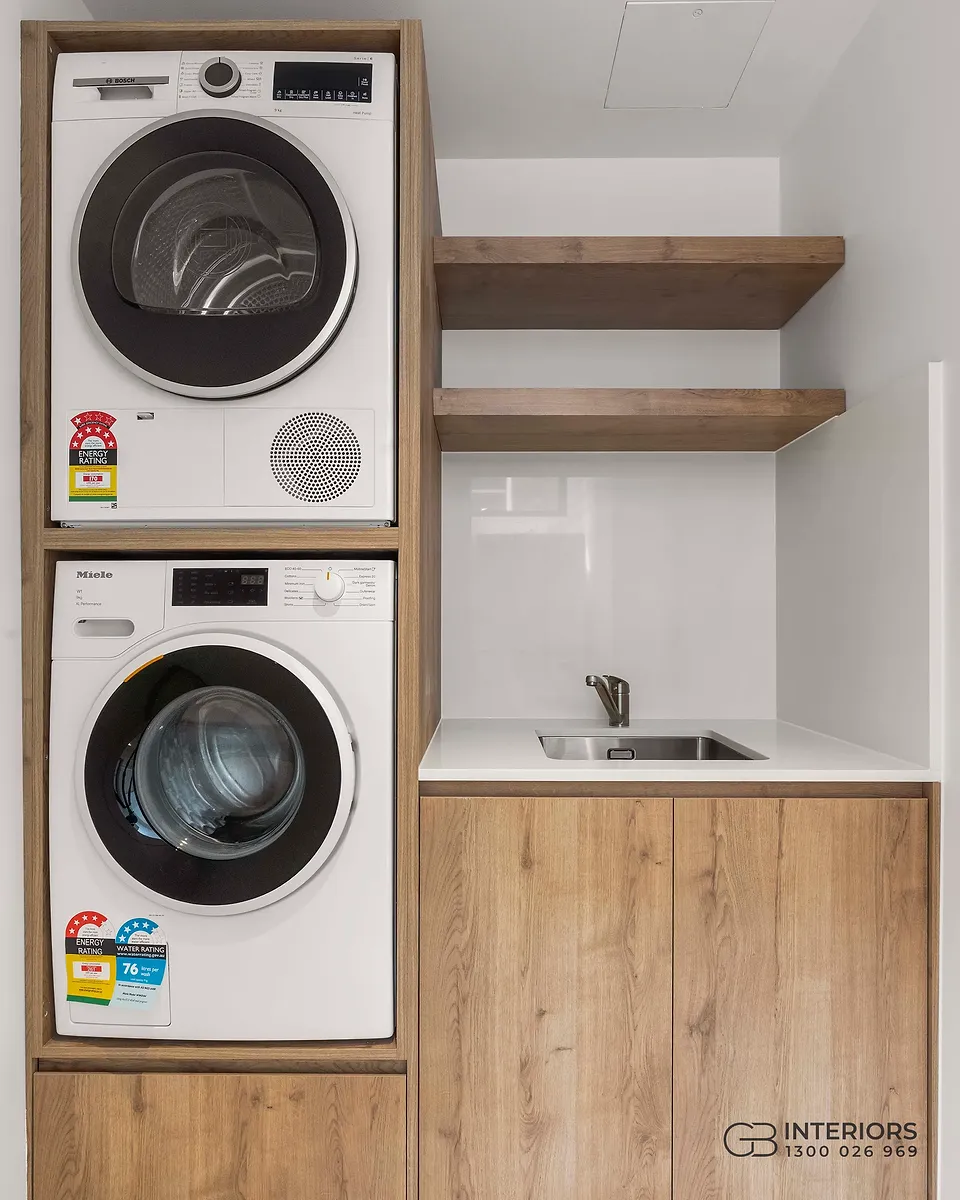
Galley. Cabinetry on two facing walls, with machines and the tub on one side and tall storage or a folding bench on the other. It suits a narrow room and keeps every task within a step.
Single wall. Everything along one wall: machines, tub, bench and wall cabinets above. It's the shape most often hidden behind doors, and it works in a hallway or beside a kitchen.
L-shape. A corner adds bench length for folding and sorting, and tall storage can close one end.
A laundry in a cupboard. Often called a European laundry, it sits behind doors in a hallway, kitchen or bathroom, with the machines side by side under a bench or stacked in a tall cupboard beside a tub. It's common in Sydney apartments and terraces, where a separate laundry room isn't possible.
What does a laundry need to work well?
Start with the essentials, then add the details that make the room a pleasure to use. In a house, the National Construction Code requires "clothes washing facilities, comprising at least one washtub and space in the same room for a washing machine," and it adds: "A kitchen sink or washbasin must not be counted as a laundry washtub." In apartment buildings it also asks for drying facilities: "clothes line or a hoist with not less than 7.5 m of line, or space for one heat operated drying cabinet or appliance in the same room as the clothes washing facilities."
The bench is where most of the work happens, so its height and depth matter. Houzz Australia's guide to laundry measurements notes that base cabinets "are designed to have a benchtop height of approximately 900 millimetres," and that "standard laundry cabinetry usually has a depth of about 600 millimetres for your base cabinets (it's best to aim for a depth of 650 millimetres), and about 300 millimetres for the upper cabinets above your benchtop." The extra depth helps where machines sit under the bench, with their hoses and taps behind.
These numbers are where most designers begin:
| Element | Starting dimension | Source |
|---|---|---|
| Bench height | about 900 mm | Houzz Australia |
| Base cabinet depth | about 600 mm, ideally 650 mm | Houzz Australia |
| Wall cabinet depth | about 300 mm | Houzz Australia |
| Tall cupboard for broom, ironing board and vacuum | at least 1,800 mm high and 600 mm wide | Home Beautiful |
| Clearance around one maker's heat pump dryer | 20 mm at the sides, top and rear | Fisher & Paykel |
| Drying line in an apartment laundry | at least 7.5 m, or space for a dryer | NCC |
| Laundry exhaust fan | at least 40 L/s | NCC |
| Openable ventilation without a fan | at least 5% of the floor area | NCC |
Clearances vary from model to model, so choose the machines before the cabinetry is drawn, and design around their installation guides.
Laundry storage ideas that earn their place
A laundry is used most when it's busiest, so everything should have a place within reach of the bench.
- A tall cupboard for the broom, the ironing board and a stick vacuum. Home Beautiful suggests one at least 1,800 mm high and 600 mm wide.
- Pull-out hampers under the bench, one for each load, so sorting happens as clothes come in.
- Drawers for pegs, cloths and detergent pods, rather than a crowded shelf.
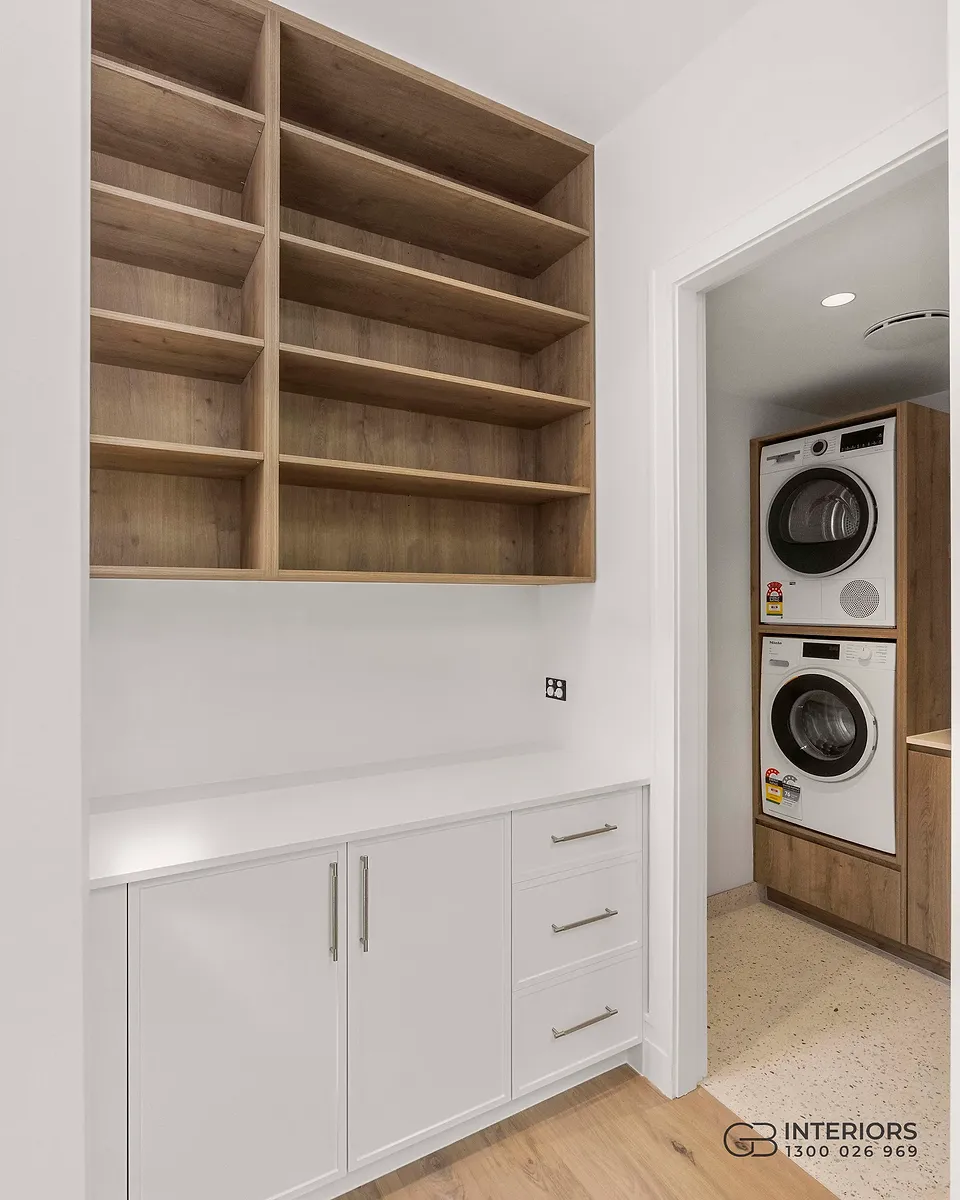
- Wall cabinets or open shelves above the machines for detergents and baskets, at a height you can reach.
- A hanging rail above the bench, so shirts go straight from the dryer onto hangers.
- Space for the bins and recycling, if the laundry doubles as the back entrance.
Interior designer Emma Mackie of M Interiors makes the point that clever storage only works when it's planned properly: "Pull-outs need adequate clearance, drying racks need sufficient airflow, and concealed storage needs to remain easy to access. When these details are considered from the outset, clever features become more than a novelty — they make the room function better."
Ideas for drying, folding and ironing
A folding bench. Keep a length of bench clear for folding, ideally beside the dryer, so clothes come out and are folded without being carried anywhere.
A drying cupboard. A tall cupboard with rails and warm, moving air dries delicates out of sight. The ventilation is the detail that makes it work, and it can be beautiful too. Interior designer Kate Walker of KWD told Home Beautiful that "The best ventilation is the least visible," and explained: "When we design drying cupboards, ventilation becomes part of the joinery itself, concealed within bespoke grilles or finely detailed openings that complement the cabinetry. True luxury is when technical requirements quietly disappear into the design."
The right dryer. The Australian Government's Energy Rating guide explains that heat pump condenser dryers "don't require venting to the outdoors, either capturing condensed water in a removable container or draining it away if the dryer is plumbed in," and that "an efficient heat pump dryer uses 60% less energy than a conventional dryer." A vented dryer is different: under the National Construction Code, "Where a venting clothes dryer is installed, it must discharge directly or via a shaft or duct to outdoor air."
Ironing. A fold-out ironing board inside a drawer or a tall cupboard keeps the board out of sight, with a power point placed for it.
A hidden laundry: behind doors, in a hallway or kitchen
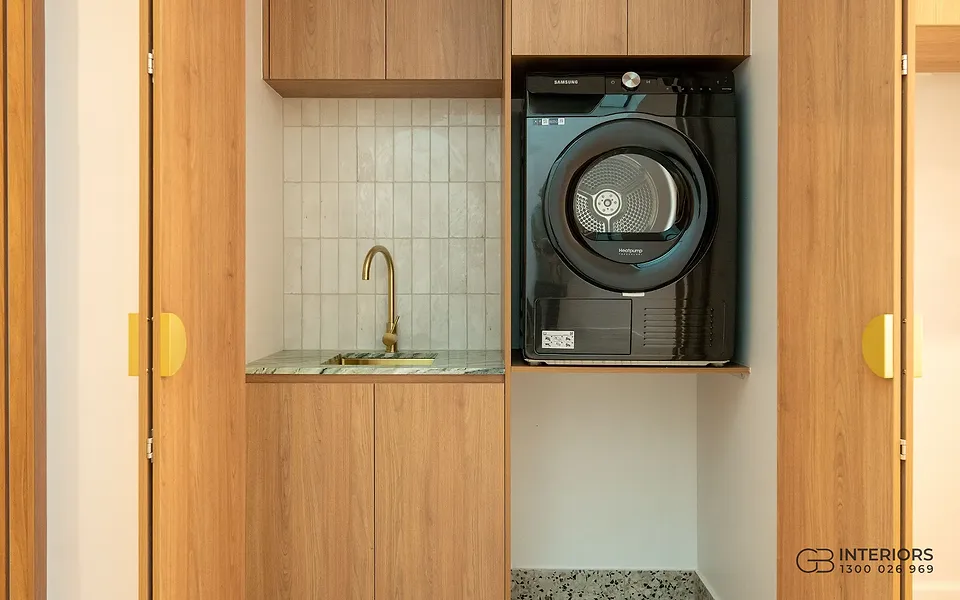
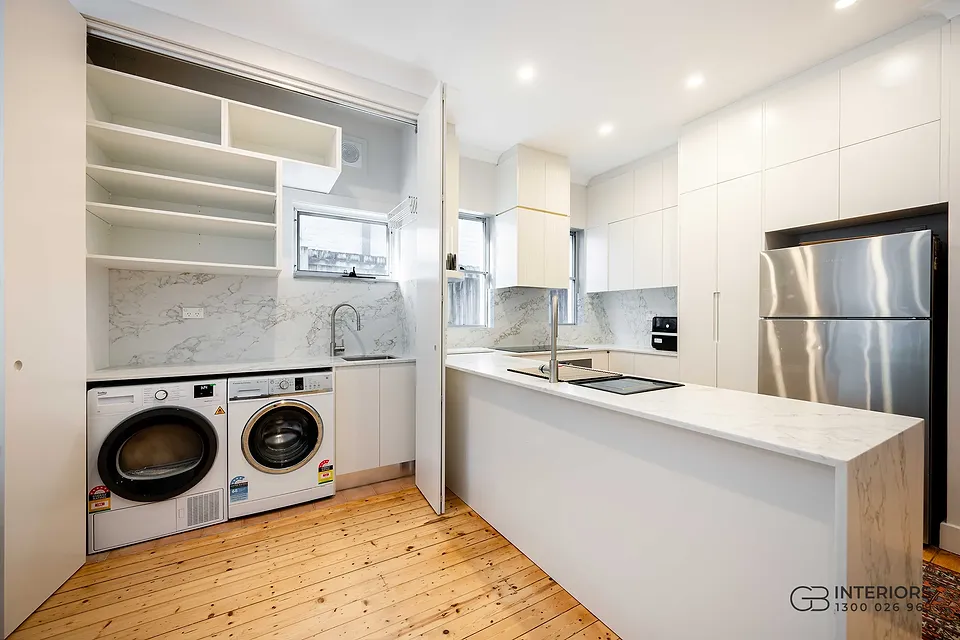
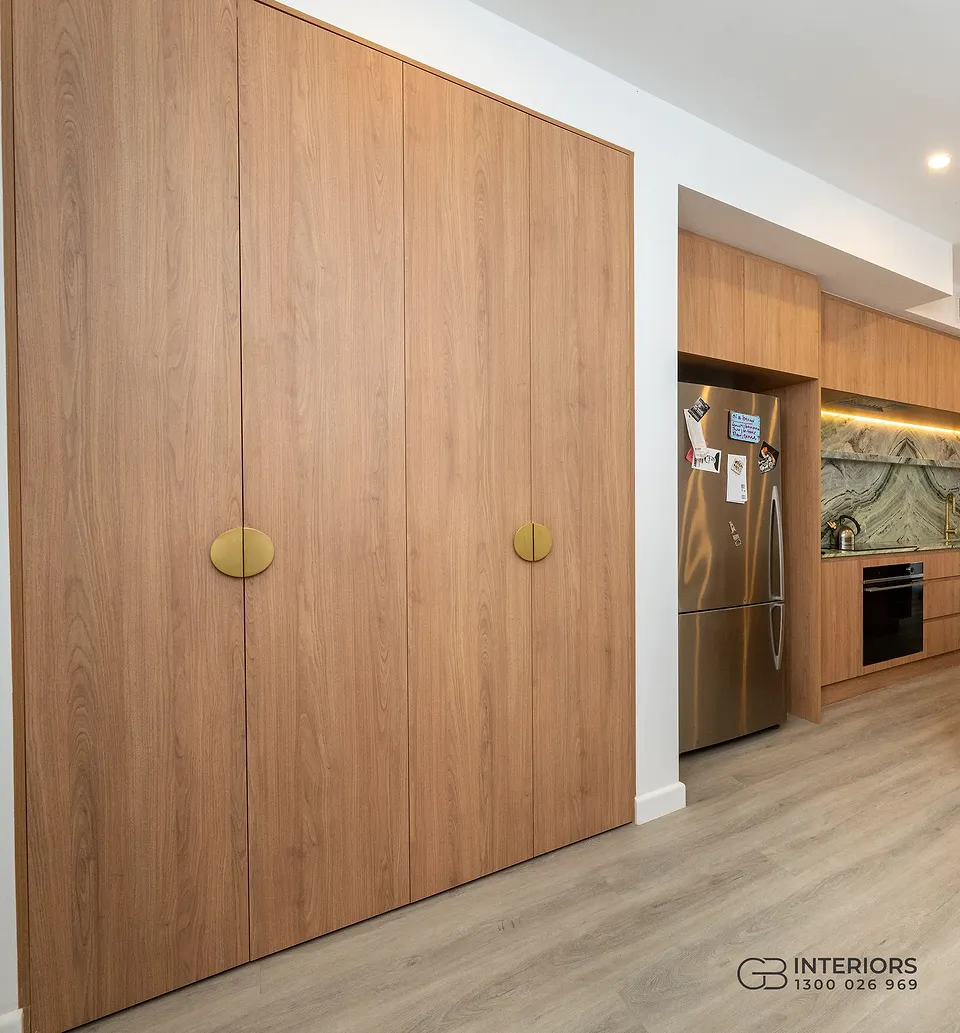
In apartments, terraces and open-plan homes, the laundry often lives behind doors. Done well, it disappears completely: the doors match the joinery around them, and when they close, the laundry reads as a wall of cabinetry. At Woolloomooloo, the laundry sits behind woodgrain bifold doors with brass handles. In North Bondi, a concealed laundry shares the kitchen's white bench and open shelving.
The doors deserve careful thought:
- Bifold doors open wide in a shallow space and fold back out of the way.
- Tall hinged doors look like the rest of the joinery, but need room to swing.
- Pocket or cavity doors slide away completely, though check your dryer first.
Check your dryer's installation guide before choosing doors, because some don't allow them in front. One leading maker's guide reads: "Do not install the dryer behind a lockable door, sliding door, or behind a door where the hinge is on the opposite side to that of the dryer in such a way that the full opening of the door is inhibited. Ensure the dryer door can always be opened fully." The same guide is clear about stacking: "A stacking kit MUST BE USED between the products and fitted correctly to the washing machine and dryer, as per the stacking kit instructions," and it lists "A washer stacked on top of a dryer" as unsafe.
Which materials stand up to water and steam?
The cabinetry. Laundry carcasses should be made from moisture-resistant board, with every cut edge sealed. Laminex describes its Lamiwood MR as "a moisture-resistant decorated MDF used for kitchen and bathroom joinery, laundries and built-in cabinetry such as study nooks and TV units." Ask what your laundry's cabinets are made from, particularly under the tub and around the machines.
The doors. Painted polyurethane gives a smooth, wipeable surface in any colour. Woodgrain and solid-colour boards are hard-wearing and consistent, and timber veneer brings warmth to a laundry that's open to the house.
The bench and splashback. Porcelain and natural stone are durable choices for a bench around a tub. A splashback behind the tub and taps protects the wall where water lands most.
The base. Raise cabinetry on a plinth or legs where the floor may get wet, and seal where the cabinetry meets the floor, so a spill never reaches raw board.
What rules apply to laundries in New South Wales?
Waterproofing. For laundries, the National Construction Code's housing provisions say: "The floor of the room must be water resistant. Wall/floor junctions must be water resistant, and where a flashing is used, the horizontal leg must not be less than 40 mm." The Australian Standard for waterproofing, AS 3740:2021, "Sets out minimum requirements for the materials, design and installation of waterproofing for domestic wet areas" in houses and apartments. In New South Wales, the Government is clear that "Waterproofing work is trade work," which needs the right licence.
Ventilation. A laundry needs either openable windows or vents, "with a ventilating area not less than 5% of the floor area of the room required to be ventilated," or mechanical ventilation. Where an exhaust is fitted, it "must have a minimum flow rate of— 25 L/s for a bathroom or sanitary compartment; and 40 L/s for a kitchen or laundry."
Licensed trades. Moving taps, drains or power is licensed work. The NSW Government says: "You need the right licence or certificate to do plumbing, draining, or gasfitting work," and "Property owners are responsible for ensuring electrical wiring work is done by a licensed electrician." Plan their work with the joinery, so the services land exactly where the drawings show them.
What's changing right now
A new building code. "NCC 2025 was published on 1 May 2026," and the Australian Building Codes Board lists New South Wales as adopting it on 1 May 2027. The laundry rules quoted above read the same in the new edition.
New energy rules for dryers. A new national standard for clothes dryers, the Greenhouse and Energy Minimum Standards (Rotary Clothes Dryers) Determination 2024, commenced on 4 October 2025 and updates their testing and labelling. Look for the current Energy Rating label when choosing a dryer.
Laundries designed like kitchens. Designers looking ahead describe concealed pull-outs, built-in drying and storage that's planned for clearance and airflow from the first drawing, as in Emma Mackie's advice above. The laundry is being treated as a room worth designing, not a cupboard for machines.
Our perspective
A laundry is used more often than almost any room in the house, yet it's often the last to be planned. We think it deserves the same care as a kitchen: a bench at the right height, storage for everything that would otherwise sit on the floor, and finishes that still look calm after years of steam and splashes.
The quiet details matter most. A cupboard sized to the detergent and the iron, a shelf that clears the dryer door, a tall door that hides the whole laundry when guests arrive. Our team designs, crafts and installs each laundry itself, so these details are drawn, made and fitted by the same people. If the laundry sits near your bedrooms, our guide to built-in wardrobes shows how the same care carries into the rooms where clothes are kept.
FAQ
What is a European laundry?
It's a laundry behind doors, usually in a hallway, kitchen or bathroom, with the washing machine and dryer side by side under a bench or stacked in a tall cupboard beside a tub. It's common in Sydney apartments and terraces, where there's no room for a separate laundry.
Can you put a dryer on top of a washing machine?
Yes, with the maker's stacking kit fitted as their instructions describe. Never stack a washing machine on top of a dryer, and check the dryer's installation guide for clearances and door requirements before the cabinetry is designed.
Does a laundry need to be waterproofed?
The National Construction Code requires a laundry floor and the junctions between the walls and floor to be water resistant. Waterproofing of wet areas follows the Australian Standard AS 3740, and in New South Wales waterproofing is licensed trade work.
How high should a laundry bench be?
About 900 mm is the usual bench height, over base cabinets about 600 mm deep, or 650 mm where machines and their hoses sit under the bench.
Can I use a sink instead of a laundry tub?
Not to meet the National Construction Code's laundry requirement in a house: a kitchen sink or washbasin can't be counted as the laundry washtub. Many compact laundries use a slim tub set into the bench instead.
Begin your laundry
See the hidden laundry behind woodgrain doors in Woolloomooloo, the concealed laundry beside the kitchen in North Bondi and the laundry we made at Willoughby, or learn more about our custom laundries.
Every project begins with a complimentary consultation. Choose one at home, and our mobile showroom comes to your door, with designs, colours and samples to choose from in the light you'll live with. Bring the model numbers of your washer and dryer if you have them.
To have a laundry made around the way your home really runs, book your complimentary consultation.
Sources
- Functional laundry design ideas, Home Beautiful, Julia Fairley, 13 October 2026.
- Clever laundry room trends, Home Beautiful, Brittany Smith, 10 November 2026.
- Key measurements for designing your dream laundry, Houzz Australia, 27 July 2022.
- Part 10.4 Facilities, National Construction Code 2022, Housing Provisions, Australian Building Codes Board.
- Part F4 Sanitary and other facilities, National Construction Code 2022, Volume One, Australian Building Codes Board.
- Part 10.2 Wet area waterproofing, National Construction Code 2022, Housing Provisions, Australian Building Codes Board.
- Part 10.6 Ventilation, National Construction Code 2022, Housing Provisions, Australian Building Codes Board.
- Part 10.8 Condensation management, National Construction Code 2022, Housing Provisions, Australian Building Codes Board.
- NCC 2025 state and territory adoption information, Australian Building Codes Board.
- AS 3740:2021 Waterproofing of domestic wet areas, Standards Australia, published 23 July 2021.
- Waterproofing work, NSW Government, updated 23 June 2026.
- Plumbers and drainers, NSW Government.
- Electrical safety at home, NSW Government.
- Clothes dryers, Energy Rating, Australian Government.
- Clothes dryers: industry information, Energy Rating, Australian Government.
- DH9060P heat pump dryer installation guide, Fisher & Paykel.
- A guide to decorated board, Laminex.