Timber Kitchen Cabinets: Species, Veneer, Finishes and Fit
By GB Interiors · · 11 min read
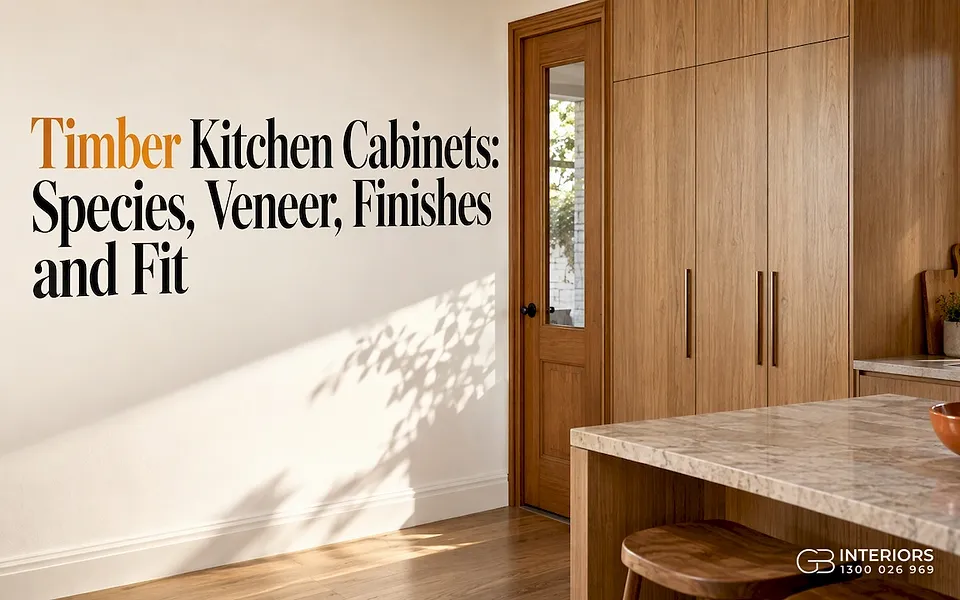
The best timber kitchen cabinets are the ones where the material, the finish and the construction suit the room they live in. Real timber veneer over a stable board gives most homeowners the grain they love with far less movement. Solid timber is best kept for the doors, drawer fronts and benchtops in full view. And a factory-applied finish, with accurate shop drawings, does more for the long-term result than the species named on the quote. We design, make and install bespoke kitchens in Sydney with one in-house team, and this guide is written for people ready to commission a kitchen, not only to browse.
Key Takeaways
- Timber kitchens come in three tiers: timber-look surfaces, real timber veneer and solid timber. Each behaves differently with humidity, heat and daily wear.
- Species and finish matter equally. Finish performance varies with the species and density of the timber, and factory-applied coatings tend to last far longer than finishes applied on site.
- Settle where each tier goes, door by door, in detailed shop drawings before any board is cut.
- Timber is a natural material, so a gentle routine of wiping spills promptly, using chopping boards and re-coating when needed keeps it beautiful for years.
- Made-to-measure sizing removes the filler panels that eat into storage when your room doesn't divide neatly into standard widths.
What does "timber kitchen cabinets" really mean?
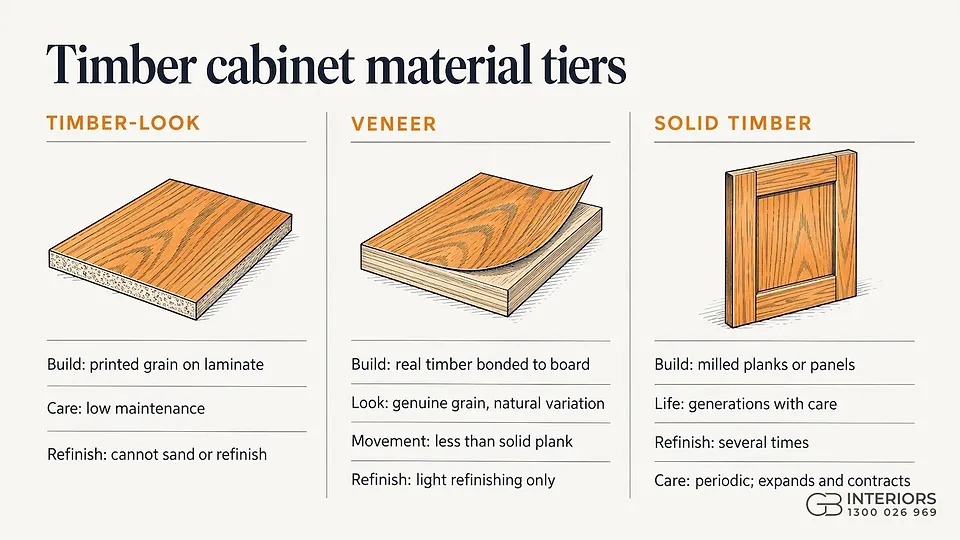
The phrase covers very different products, and what you're offered depends on which one you mean. A useful way to sort them is the three tiers set out in Havwoods' Australian guide to choosing timber for cabinets.
Timber-look surfaces are boards finished with a woodgrain, such as laminate or melamine. They're low-maintenance and consistent from door to door, but the grain is a surface rather than timber, so it can't be sanded back or refinished. Premium woodgrain boards are what many beautiful contemporary kitchens use, including several of ours.
Timber veneer is a thin slice of real timber bonded to a stable board such as MDF or plywood. You get genuine grain and natural variation, and because the core is a manufactured board, veneer moves far less than a solid plank. It can be refinished only lightly, and the quality of the board beneath matters.
Solid timber is milled planks or panels. Havwoods notes it "can last for generations when properly installed and maintained" and can be sanded and refinished multiple times. It's also the most demanding of the three, needs periodic care, and expands and contracts with humidity.
Most custom kitchens become a considered mix: solid timber where it's seen and touched, veneer across larger panels such as tall pantry doors and island ends, and a moisture-resistant board for the cabinet carcasses. That isn't a compromise. Large solid panels are the ones most likely to move, so using veneer where a surface is broad and flat is simply good construction.
Where does solid timber earn its place?
Solid timber is usually kept for the doors, drawer fronts and benchtops in full view. Its edges can be routed and shaped without a separate edging, which is why it suits profiled shaker doors, beaded details and softly rounded benchtop edges. Our guide to popular kitchen door styles shows which profiles suit which kitchens.
Where is veneer the wiser choice?
Veneer suits flat, full-height panels and feature walls where you'd like the grain to run continuously. Because the board beneath is stable, a long run of doors stays flat, and the grain can be matched from one door to the next. The care point is the edge: veneer needs well-sealed edges and joints, and it's happiest where humidity is steady. A well-run workshop seals every edge as part of manufacture, which is one more reason computer-cut parts and careful shop drawings matter.
How do you choose a timber species?
Every species has its own colour, hardness and way of taking a finish. Australian hardwoods are a natural starting point for local homes, and CUTEK's guide to Australian timbers describes three favourites:
| Species | What CUTEK notes | In a kitchen |
|---|---|---|
| Blackbutt | Responds well to stains and finishes | Can be left natural or tinted to suit the room |
| Spotted gum | Colours from light brown to dark red, with a lower tannin content, so it won't "bleed" as much | Ideal for clear coatings and finishes |
| Jarrah | A premium Australian timber that "looks best as a feature" | A rich, characterful island or shelving |
Inside the kitchen, what matters most is how stable the timber is and how its finish performs. Forest and Wood Products Australia's Technical Design Guide 14, Timber in Internal Design, makes several points worth carrying into your brief:
- The performance of a finish varies with the species and density of the timber beneath it.
- Seasoned timber, at 10 to 15% moisture content, is a more stable base than green timber.
- For paint systems, quartersawn timber is more stable than backsawn.
- Heartwood is naturally more durable than sapwood.
In practice, the conversation with your cabinet maker should cover how the timber is dried, how boards are selected and how doors are made, not only the species and the colour.
Why do finishes decide the long-term result?
A finish does three things. It protects the timber from moisture and stains, it shapes how the grain looks, and it sets the care you'll give it for years.
Oil finishes soak into the timber, give a natural matt look and are easy to touch up, but they need reapplying from time to time. They suit benchtops, shelves and quieter doors where you enjoy a hand-finished quality.
Lacquers and water-based clear coats build a harder, stain-resistant surface with less ongoing care. They suit doors and drawer fronts around the cooktop and sink, where splashes are constant.
Paint and polyurethane give a durable, wipe-clean surface in any colour, and pair beautifully with timber elsewhere in the room.
The point that matters most is where the finish is applied. TDG 14 is clear: "Factory-coated finishes tend to have significantly longer service lives than site-applied finishes, as factory finishing allows superior coatings to be applied in controlled conditions." That is a strong reason to have cabinetry made and finished in a workshop rather than sprayed or brushed in your kitchen. Once the coating is on, it should be protected through storage, installation and the rest of the build, and because factory finishes often need a special repair, any damage should go back to the maker.
We machine, assemble and finish our joinery in our own Sydney facility, so the doors you see on installation day have been finished and handled by the team that made them.
What sizes suit timber cabinets?
Timber cabinets look their best when the proportions are right, and Australian kitchens follow a set of common dimensions. Robert Mann Architecture's kitchen sizing guide gives these figures, and notes that kitchen benchtops need to comply with Australian Standard AS 4386-2018:
| Element | Typical figure |
|---|---|
| Bench depth | 600 mm |
| Bench height | 900 mm, adjustable from 850 to 1,050 mm |
| Kickboard | 150 mm high, 50 mm deep |
| Bench thickness | 33 to 40 mm |
| Cabinet door width | 600 mm at most |
| Benchtop to the underside of wall cabinets | 450 mm |
| Top of the burner to the underside of the rangehood | 600 mm |
These are starting points, not rules to apply blindly. Many rooms, especially in older Sydney terraces and renovated apartments, don't divide into neat standard modules. When a wall leaves a gap, a standard kitchen fills it with a filler panel, and that's storage you've paid for but can't use. Custom cabinets are made to the real wall, so the gap disappears and the grain can run continuously across the doors. With a tall ceiling, a bulkhead or an awkward corner, custom sizing also lets doors and panels reach exactly the right height.
This is where detailed shop drawings earn their place. Before manufacture, every cabinet, door, joint and grain direction is drawn and confirmed, so you, your designer or your builder can check each dimension against the site before computer-controlled machines cut to those drawings.
Which colours and details suit timber?
Timber brings a kitchen its warmth, so the choices around it should let it lead. These are principles we apply rather than rules:
- Let one timber lead. Several species in one kitchen usually look accidental. Choose the main timber, then repeat it in one or two places, such as the island and a floating shelf.
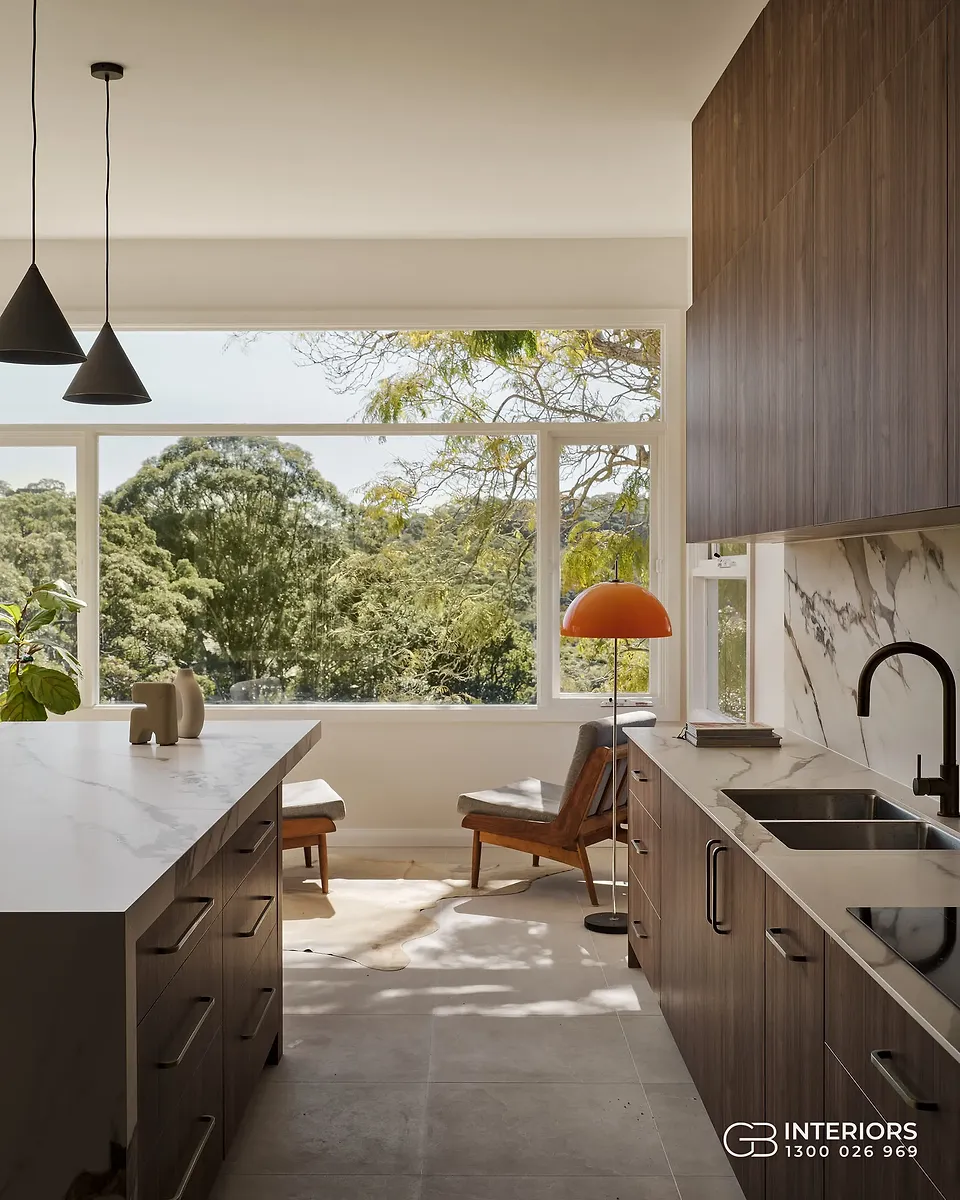
- Pair timber with calm surfaces. Natural stone, marble and porcelain all sit comfortably beside timber, and plain painted or polyurethane doors let the grain stand out by contrast.
- Match the undertones. A red-brown species such as jarrah suits warm whites and deep greens; paler, honeyed tones suit soft greys, stone, and brass or black hardware.
- Consider the light. North-facing rooms bring out warm tones; darker rooms often suit lighter timbers or a paler finish.
- Keep the grain direction consistent. Vertical grain on tall doors lengthens a room, while horizontal grain on an island feels broader.
- Put timber where you'll touch it. Island ends, drawer fronts, handles and open shelves bring timber within reach, while the rest of the cabinetry can stay quieter.
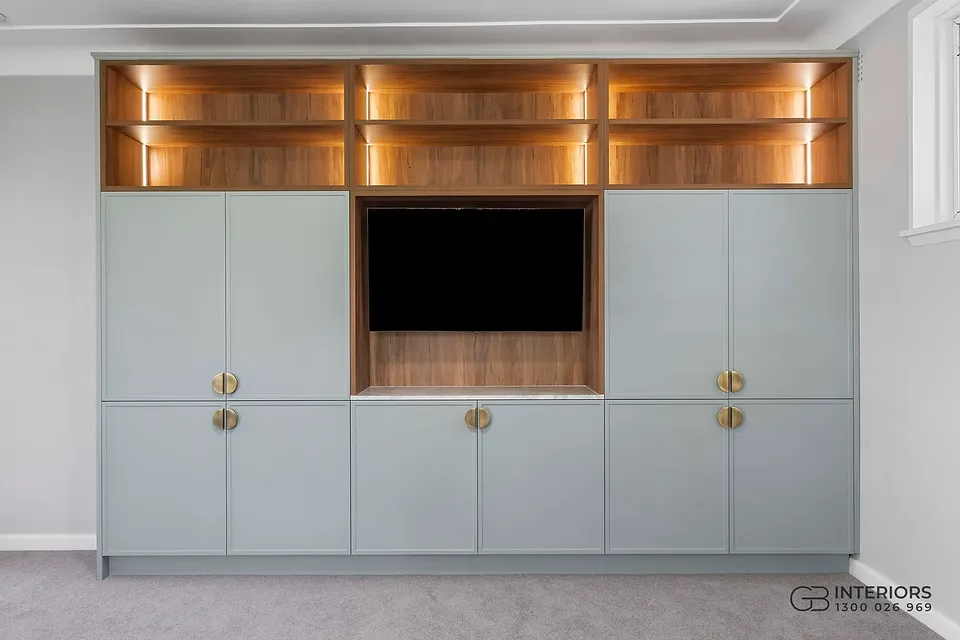
Browse the designs we can create for you to see how finishes, stone and timber work together. When the kitchen is part of a larger plan, the same timber can carry through to a media wall, study or wardrobe, so the whole home feels of a piece.
How do you care for timber cabinetry?
Timber is a natural material, so a little routine keeps it at its best. Architecture & Design suggests finishing timber before installation with a durable varnish or polyurethane, which, depending on its condition, needs resurfacing only about every two years, while a timber benchtop with a natural matt finish can be oiled once a year. Its everyday advice is simple:
- Wipe up spills as soon as they happen.
- Don't place very hot pans directly on a timber surface.
- Use a chopping board rather than cutting on the benchtop.
- Keep water away from the edges and joints around the sink and dishwasher.
The habit that matters most is the first: spills left to sit are what mark timber. Ask for the name of your finish and its care instructions, so you can follow the right routine.
What should you specify when commissioning timber cabinetry?
Whether you're a homeowner, a builder or a designer, a good brief for timber cabinetry covers:
- The standard. Kitchen benchtops need to comply with AS 4386-2018, the Australian Standard for cabinetry.
- The tier by location. Where solid timber, veneer and painted or polyurethane surfaces go, door by door and panel by panel.
- Species and selection. The timber, the grain direction, and how boards will be matched across doors.
- The finish system. A factory-applied finish, and who protects it during installation.
- Shop drawings. Detailed drawings to approve before manufacture, including joints, edges and hardware.
- One point of accountability. Who designs, makes and installs. When one team handles all three, every question has one answer.
Our guide to choosing a kitchen joinery company in Sydney covers further questions to settle before you sign.
Timber beyond the kitchen
The same decisions carry through the home. Timber and woodgrains work beautifully in wardrobes and walk-in robes, bathroom vanities and TV units and media walls, where the choice of finish and care around moisture matter in the same way. Outdoors needs its own approach, which we cover in our guide to outdoor kitchen cabinets for Sydney.
Our perspective
Timber is the one kitchen material people ask for by feeling rather than by specification. They want warmth, grain and something that looks as though it belongs in the house. Our role is to turn that feeling into a kitchen that's beautifully made and lasts.
The decisions that matter most are made before any timber is cut. Where does real timber go, and where does a stable veneer or a fine woodgrain do the job better? Which finish will stand up to the splashes around the sink? How does the grain run across a long wall of doors? Those questions are answered on paper, in detailed shop drawings, which is why we draw everything before manufacture.
Keeping design, manufacture and installation in one in-house team is how we stay in command of those answers. The people who draw the doors answer for how they're made and fitted, every panel is machined on computer-controlled equipment, and every finish is chosen for a kitchen that's used every day.
FAQ
Is solid timber or veneer better for kitchen cabinets?
Neither is better everywhere. Solid timber suits visible doors, drawer fronts and benchtops, and can be refinished several times. Veneer gives real grain on a more stable board, so it suits large, flat panels. Many custom kitchens use both.
What's the difference between timber veneer and timber-look boards?
Veneer is a thin slice of real timber bonded to a stable board, so the grain is genuine and can be lightly refinished. Timber-look boards carry a woodgrain finish rather than real timber: they're consistent, durable and low-maintenance, but they can't be sanded back.
How do I look after timber kitchen cabinets?
Wipe spills promptly, keep very hot pans off timber, and use chopping boards. A varnish or polyurethane finish may need resurfacing about every two years, and a natural oiled benchtop is usually re-oiled once a year. Your cabinet maker can confirm the routine for your finish.
What are standard kitchen cabinet sizes in Australia?
Benchtops are commonly 600 mm deep and 900 mm high, with a 150 mm kickboard, and cabinet doors are generally up to 600 mm wide. When your room doesn't divide into standard widths, custom cabinets avoid filler panels and make full use of the space.
Begin your timber kitchen
See how warm woodgrains and stone come together in our Castlecrag walnut kitchen, explore our materials and finishes, or learn more about our custom kitchens.
Every project begins with a complimentary consultation. Choose one at home, and our mobile showroom comes to your door, with timbers, woodgrains, colours and samples to choose from in the light you'll live with.
To bring the warmth of timber into your kitchen, book your complimentary consultation.
Sources
- Choosing timber for cabinets: timber-look vs veneer vs solid timber, Havwoods.
- Five Australian timbers from our neck of the woods, CUTEK, 2018.
- Technical Design Guide 14: Timber in Internal Design, Forest and Wood Products Australia.
- The ageless appeal of timber kitchens, Architecture & Design.
- Kitchens: standards, sizing and materiality, Robert Mann Architecture.